Disguising the message
Substitution ciphers replace each character in a message with either another letter, a number, or a symbol through a defined substitution alphabet. Popular ones you might see are the Atbash cipher, the Caesar shift, the A1Z26 cipher, the Polybius square, and the Pigpen cipher. The former two rely on shifting the order of the alphabet. The Atbash cipher uses the alphabet backwards, swapping each letter for its opposite, e.g. A=Z, B=Y, C=X, etc., and can be seen in Hebrew in the Old Testament. The Caesar cipher, instead, moves each letter of the alphabet a certain number of spaces. The number of spaces would be considered its key. A Caesar shift of 13, for example, would show A=N, B=O, C=P, etc.
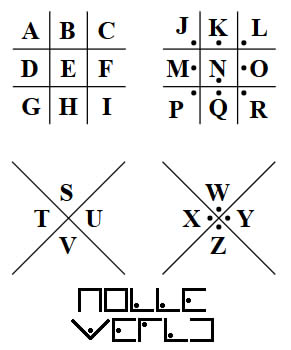
Other simple substitution ciphers don't use the alphabet whatsoever, but instead replace each letter with a number or symbol. A1Z26 replaces each letter with its corresponding place in the alphabet as a number (e.g. A=1, B=2, C=3, etc.). While it isn't the only method that uses numbers, it's recognizable by the fact the ‘letters’ can have either one or two digits and the individual values never exceed 26. The Pigpen cipher replaces each letter with a geometric symbol. While these symbols are less recognizable than numbers and the Latin alphabet, they too follow a straightforward grid pattern. It's also sometimes called the tic-tac-toe cipher due to its use of right angles and dots.