Protecting the message
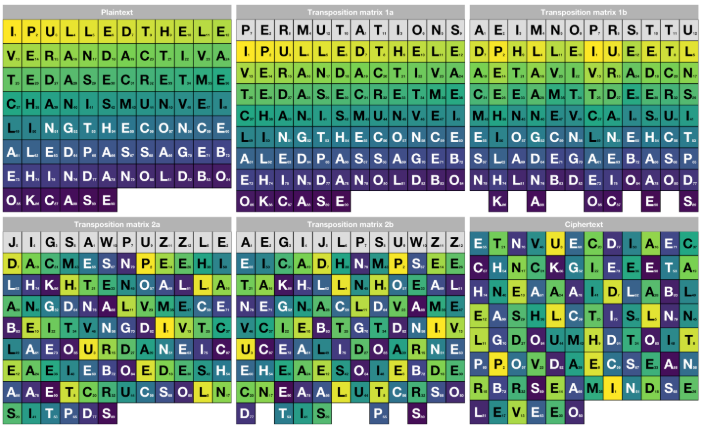
Cryptography is the practice of encrypting messages through use of codes and ciphers and typically needs a key or password to properly decrypt and understand, and this website gives a brief history and aims to familiarize readers with a few simple forms of it. Cryptography's history goes back thousands of years, first being recorded in Egypt circa 1900 BC as character substitution. The first documentation of cryptoanalytic methods was in modern day Iraq, that region now being considered the birthplace of modern cryptography. Much of this era of cryptography saw its primary use in military communications from Ancient Greece up until World War II. The methods used were typically transpositional ciphers, which keep the characters intact but scramble them, and substitution ciphers, which change the letters themselves. In this era, the focus was on linguistic patterns to protect information.
This changed with time and especially in the past century. After World War II, businesses started demanding encryption to protect their sensitive information from competitors. Beginning in the late 1940s the focus shifted towards complex mathematics allowing for more sophisticated encryption algorithms. This was necessary because, just as the computer age brought more security, it also gave hostile parties access to the tools needed to break it. A few decades later, in the 1970s, IBM developed the Data Encryption Standard and we saw the origins of the public key cryptosystem. Cryptography is an evolving practice even in the 21st century as the rapid evolution of technology and cybersecurity remain concerns with quantum computers looming on the horizon.